


%%JOTOC_TITLE%%
The History of Kingdom of Jerusalem
The Kingdom of Jerusalem was a Latin Christian state that emerged as a result of the First Crusade and ruled a region of varying size in the Levant from 1099 to 1291. It was the most significant of the Crusader states, as its capital was Jerusalem, holy city to Christianity, and its rulers bore the title of King of Jerusalem.
The history of the kingdom, however, was not only one of constant warfare. It also included trade, pilgrimage, diplomacy, dynastic marriages, and the coexistence of different linguistic and religious groups. The Latin rulers formed a small minority in the region, who had to adapt to the surrounding Eastern Mediterranean world and build relationships with local Christians, Muslims, and Jews, as well as with the Byzantine Empire and the Italian maritime republics.
1. The First Crusade and the Founding of the Kingdom
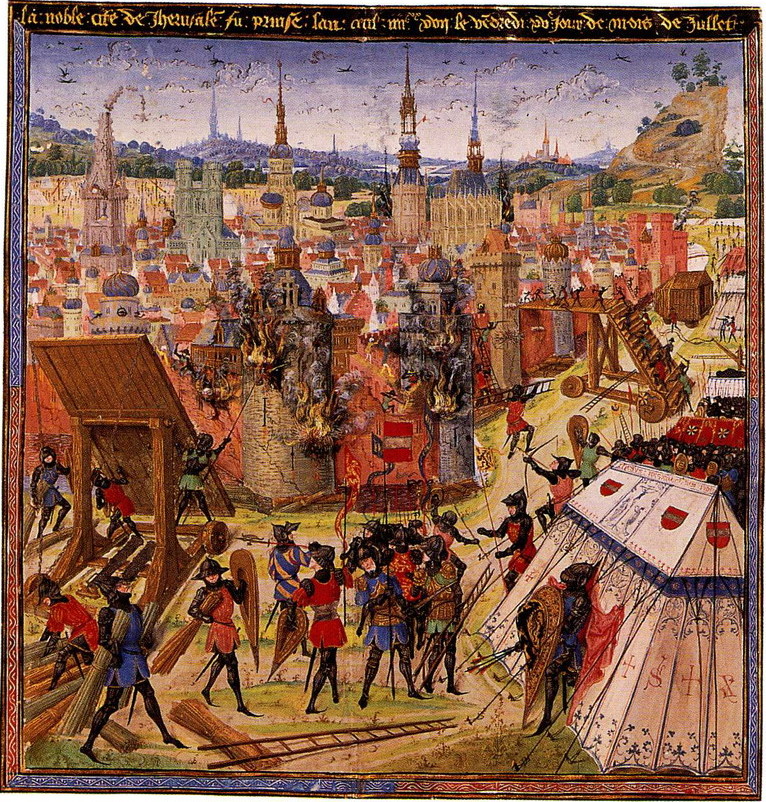

The First Crusade began in 1095, when Pope Urban II called on the princes and knights of Western Christendom to set out east. The immediate context of the crusade was a request from Byzantine Emperor Alexios I Komnenos for help in the fight against the Seljuks, but the movement soon took on the central goal of regaining Jerusalem and other holy places under Christian control.
The Crusader armies passed through Constantinople and Anatolia into Syria. After the capture of Nicaea and the Battle of Dorylaion, they continued their advance towards Antioch, which fell after a long siege in 1098. In the same year, Baldwin of Boulogne founded the first Crusader state at Edessa. From Antioch, the Crusaders eventually marched south towards Jerusalem.
Jerusalem was captured on July 15, 1099, after a siege that lasted more than a month. The conquest was followed by widespread slaughter of Muslims and Jews. The event remained a permanent part of the memory of the Crusades in both Christian and Islamic historiography.
Gottfried, or Godfrey of Bouillon, was elected ruler of the city. He did not use the title of king, but was known as the Defender or Protector of the Holy Sepulchre, in Latin Advocatus Sancti Sepulchri. After Gottfried's death in 1100, his brother Baldwin I assumed the title of king and was crowned in Bethlehem. This was the beginning of the actual Kingdom of Jerusalem.
2. Expansion
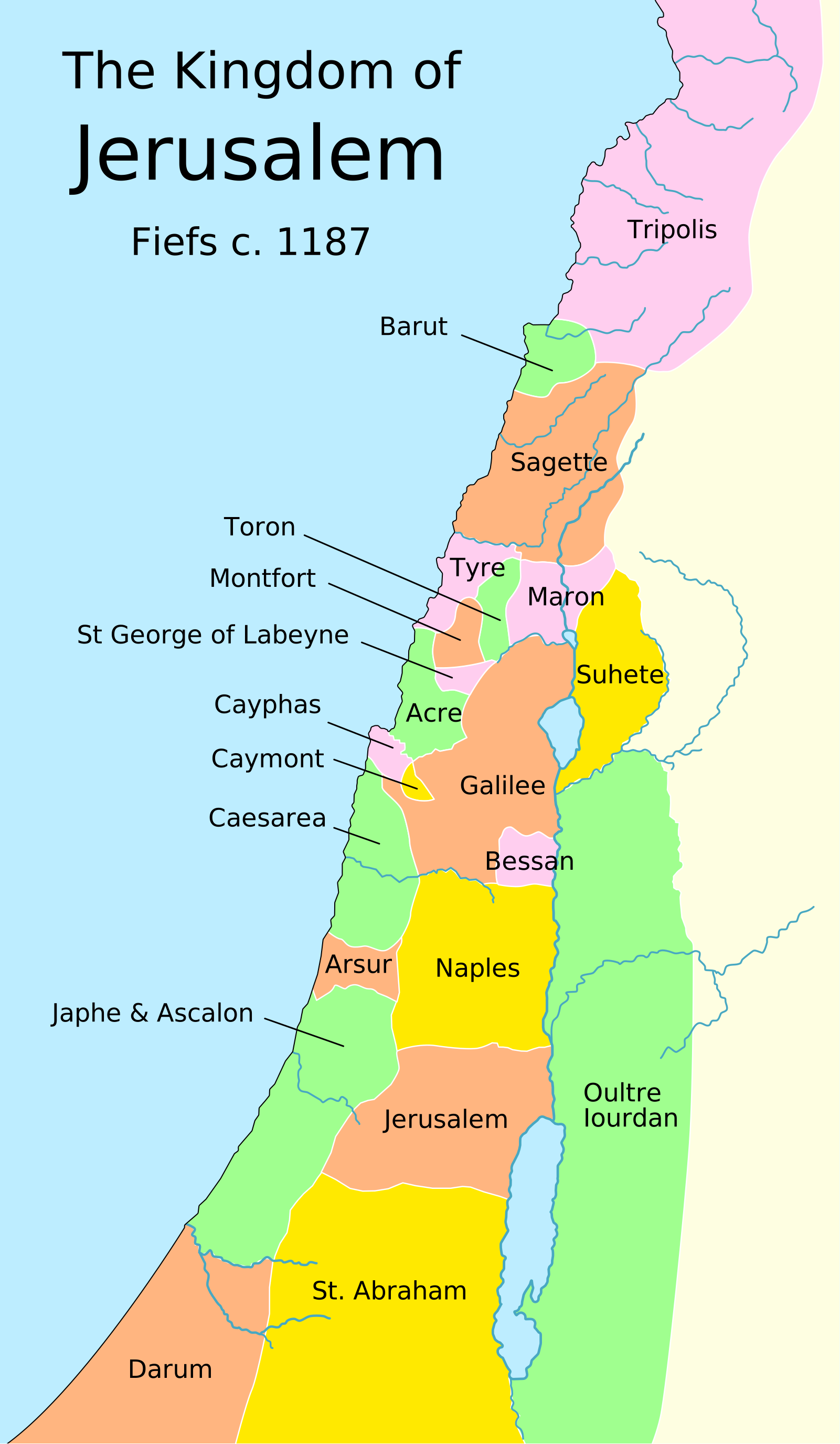

The position of the newly founded kingdom was initially precarious. Most of the soldiers from the First Crusade had returned to Europe, and the kingdom had few knights and infantry. Jerusalem was surrounded by Muslim-held territories, and access to the West depended on the ports on the Mediterranean coast.
Baldwin I began a systematic campaign to conquer coastal cities. Arsuf and Caesarea fell in 1101, Acre in 1104, Beirut and Sidon in 1110, and Tyre in 1124. The fleets of Genoa, Venice, and Pisa played a central role in the conquests. In return for their assistance, the Italian merchant cities received their own quarters in the ports, warehouses, rights, and tax breaks.
The kingdom also expanded east of the Jordan. Caravan routes and the southern border were guarded by fortresses, the most famous of which were Montréal and later Kerak. With these, the kingdom could control trade between Damascus, the Arabian Peninsula, and the Red Sea.
The capture of Ascalon in 1153 removed the last significant Fatimid base on the Palestinian coast. It also opened the way for the Kingdom of Jerusalem to Egypt. At its largest, the kingdom controlled a narrow but strategically important area from Beirut and the Galilee to the vicinity of the Gulf of Aqaba.
The kingdom was organized according to the Western European feudal model. It included large fiefdoms, such as the Counties of Jaffa and Ascalon, the Principality of Galilee, and the lordships of Sidon, Caesarea, and Transjordan. In practice, the administration combined structures imported from the West with the region's old administrative, tax, and land ownership systems.
3. Edessa, Damascus and the Second Crusade
The Crusader states initially benefited from the internal disputes between Muslim rulers. The situation began to change when Zengi, the ruler of Mosul and Aleppo, consolidated his power in northern Syria. In December 1144, his forces captured Edessa, the first major territorial loss suffered by the Crusader states.
The fall of Edessa shocked Western Europe. Pope Eugene III declared a new crusade, preached by, among others, Bernard of Clairvaux. The Second Crusade was led by King Louis VII of France and King Conrad III of Germany.
The European armies suffered heavy losses in Anatolia. The forces that reached the Holy Land met with Queen Melisende of Jerusalem and King Baldwin III to discuss the destination of the expedition. Instead of Edessa or Aleppo, the leaders decided to attack Damascus.
The decision proved to be a serious strategic error. Damascus was a Muslim city, but it had at times allied with Jerusalem against Zengi and his son Nur ad-Din. The siege, which began in July 1148, lasted only four days. The crusaders quarreled among themselves, changed positions unfavorably, and withdrew without achieving anything.
The failed attack pushed Damascus closer to Nur ad-Din, who took control of the city in 1154. Aleppo and Damascus were now under the same ruler, and a more unified opponent had formed to the east of the Kingdom of Jerusalem.
4. Alliance with Byzantium and attempts to conquer Egypt
The failure of the Second Crusade did not mean the immediate decline of the Kingdom of Jerusalem. Baldwin III and his successor Amalric I sought to strengthen the kingdom by approaching the Byzantine Emperor Manuel I Komnenos.
The alliance was strengthened by marriages. Baldwin III married Theodora Komnene, a relative of the emperor, and Amalric I married Maria Komnene. The Kingdom of Jerusalem also accepted the growing influence of Byzantium in Antioch. In return, the kings hoped to receive military and naval support from the empire.
Attention turned to Egypt, where the Shiite Fatimid Caliphate was in an internal crisis. Both Amalrik and Nur ad-Din understood that Egypt's wealth and military capabilities could decide the balance of power in the entire region. Between 1163 and 1169, Amalric made several military expeditions to Egypt and became involved in the power struggles of the country's viziers.
In 1169, a joint fleet of Jerusalem and Byzantium besieged Damietta. The expedition failed due to poor maintenance, distrust, and disagreements among the allies. Egypt was not conquered.
The consequences of the failure were fatal for the Kingdom of Jerusalem. Nur ad-Din's general Shirkuh gained control of Egypt, and upon his death, power passed to his nephew Saladin. Saladin abolished the Fatimid Caliphate in 1171 and gradually rose to rule over both Egypt and much of Syria. The Kingdom of Jerusalem was now in a situation where the same powerful ruler was able to pressure it from both the south and the east.
5. The loss of Jerusalem and the Third Crusade

King Amalric I died in 1174. He was succeeded by his son Baldwin IV, who suffered from leprosy. Despite his illness, Baldwin proved to be an effective ruler and in 1177 won a remarkable victory over Saladin at the Battle of Montgisard.
However, the king's illness and childlessness led to a difficult succession dispute. After Baldwin IV, the crown passed for a short time to his nephew Baldwin V. After his death in 1186, Sibylla was crowned queen and her husband Guy of Lusignan was crowned king.
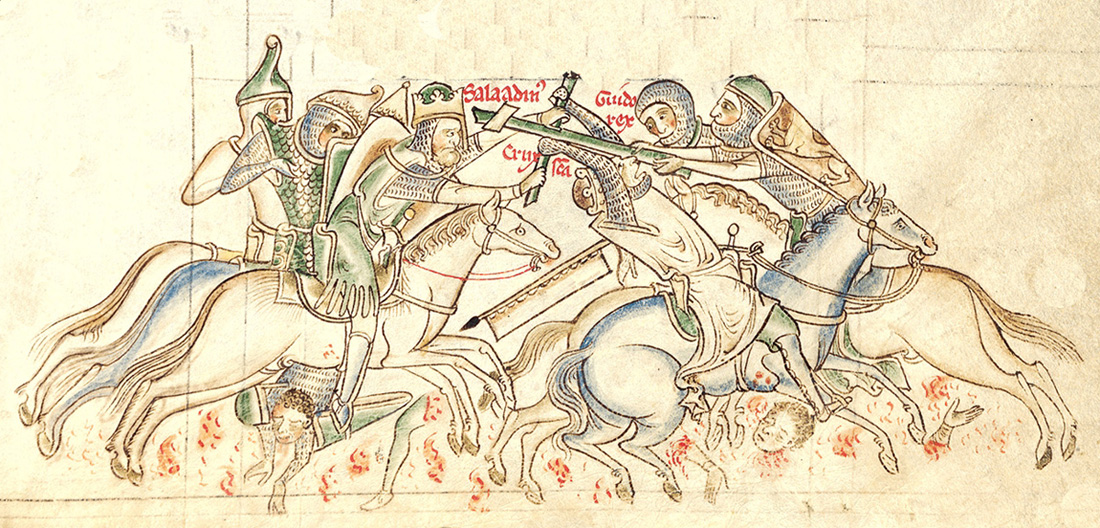
The conflicts within the leadership of the kingdom came to a head at the same time that Saladin had combined the resources of Egypt and Syria. In the summer of 1187, the Jerusalem army set out to liberate the besieged Tiberias. The army, suffering from heat, lack of water, and constant enemy attacks, was almost completely destroyed at the Battle of Hattin on July 4.
King Guy was captured, and the Christian relic of the Holy Cross fell into Saladin's hands. Most of the kingdom's castles and cities were left without defenders. Acre, Nablus, Jaffa, Beirut, and many other cities surrendered or were captured.
Jerusalem surrendered to Saladin on 2 October 1187. Balian of Ibelin, who led the city's defense, negotiated a chance for the inhabitants to ransom their freedom. Not everyone could afford the ransom, and some of the population ended up in slavery, but there was no general massacre like that of 1099.
The loss of Jerusalem led to the Third Crusade, led by Emperor Frederick Barbarossa, King Philip II Augustus of France, and King Richard the Lionheart of England. Frederick drowned en route in Anatolia, but the French and English participated in the long siege of Acre. The city was captured in 1191.
Richard defeated Saladin's forces at Arsuf and defended Jaffa but did not attempt a final assault on Jerusalem. The peace of 1192 left the coastal strip from Tyre to Jaffa under Christian control. Christian pilgrims were granted access to Jerusalem, but the city itself remained under Saladin's control.
6. Kingdom of Acre
Although Jerusalem was lost, the Kingdom of Jerusalem did not cease to exist. Conrad of Montferrat successfully defended Tyre against Saladin, and after the Third Crusade, Acre became the new political and economic centre of the kingdom.
The period is sometimes called the Kingdom of Acre or the Second Kingdom of Jerusalem. Officially, however, the name of the state and the royal title did not change: the rulers were still kings of Jerusalem, even though they did not rule Jerusalem.
Acre was one of the most important ports in the eastern Mediterranean. The Venetians, Genoese and Pisans had their own quarters in the city, built around walls, churches and administrative buildings. The headquarters of the Knights Templar, the Hospitallers and the Teutonic Order were located in or near the city.
The kingdom's economy relied on trade, port dues, and pilgrimages. Spices, silk, sugar, dyes and other products from the Eastern Mediterranean passed through the city. At the same time, the kingdom became increasingly dependent on the Italian maritime republics, whose disputes occasionally led to outright wars in the streets of Acre.
Cyprus formed an important support area for the kingdom. The island's rulers belonged to the Lusignan family, and the crowns of Cyprus and Jerusalem were later united under the same ruler. However, the actual territory of the Kingdom of Jerusalem only included coastal cities, fortresses, and the surrounding lands.
7. Fifth and Sixth Crusades
In the 13th century, the restoration of Jerusalem was once again sought through Egypt. The Fifth Crusade headed to the Nile Delta in 1218. Its most prominent leaders included the King of Jerusalem, John of Brienne.
The Crusaders captured Damietta in 1219 after a long siege. The Egyptian Sultan al-Kamil offered territorial concessions in negotiations, but the Crusader leaders believed they could achieve more by continuing the war. The army advanced towards Cairo in 1221, but was besieged by the flooding of the Nile and Egyptian forces. The Crusaders were forced to surrender Damietta and leave Egypt.
The Sixth Crusade achieved more with almost no fighting. The Holy Roman Emperor Frederick II had married Isabella II, the heiress to the throne of Jerusalem. Despite being excommunicated by the Pope, Frederick arrived in Acre in 1228.
Frederick negotiated the Treaty of Jaffa with Sultan al-Kamil in 1229. Based on it, Jerusalem, Bethlehem, and Nazareth, as well as the corridor connecting them to the coast, passed into Christian control. The Islamic holy sites on the Temple Mount remained under Muslim control, and the right of Muslims to practice their religion was secured.
Fredrik organized a coronation-like ceremony in Jerusalem, but his position was controversial in the eyes of both the church and the local nobility. The city was also difficult to defend, as its fortifications had been demolished.
The second period of Christian control of Jerusalem was short-lived. Khwarezmian troops captured and plundered the city in 1244. After this, the Kingdom of Jerusalem no longer had permanent control of the holy city.
8. The loss of Acre


In the second half of the 13th century, the Mamluk Sultanate, which had risen to power in Egypt, began a systematic attack on the remaining territories of the Crusader states. Sultan Baibars captured several coastal cities and fortresses in the 1260s and 1270s. Antioch fell in 1268, and Tripoli was lost in 1289.
Acre remained the last major Christian-controlled center in the Levant. The city had strong walls and troops from various religious orders and European merchant communities, but the defenders were weakened by internal strife and little aid from Europe.
The army of the Mamluk Sultan al-Ashraf Khalil besieged Acre in the spring of 1291. The city was bombarded with large siege engines, and its walls were weakened by digging tunnels under them. The Mamluks launched a decisive attack on 18 May.
The defenses were broken, and a large part of the population tried to escape to the ships waiting in the harbor. The last buildings held by the Templars held out for a few more days, but eventually the entire city fell into the hands of the Mamluks.
The fall of Acre marked the end of the actual territorial existence of the Kingdom of Jerusalem. Tyre, Sidon, and the other last strongholds were also emptied or soon lost. The Crusaders retreated to Cyprus.
The title of King of Jerusalem remained titular thereafter. It was used by the rulers of Cyprus and several European dynasties for centuries, but the actual Kingdom of Jerusalem was never restored.
9. Kings and reigning queens of Jerusalem
The Crown of Jerusalem was inherited on several occasions through a female heir. As a result, the rulers included both queens who ruled in their own right and their spouses who used the title of king by right of their wives.
|
Ruler |
Reign |
Notes |
|
Gottfried of Bouillon |
1099–1100 |
Defender of the Holy Sepulchre; did not use the title of king |
|
Baldwin I |
1100–1118 |
First crowned king of Jerusalem |
|
Baldwin II |
1118–1131 |
Relative of Baldwin I and former Count of Edessa |
|
Melisende and Fulk |
1131–1143 |
Melisende ruled by her own right of inheritance; Fulk was her husband. |
|
Baldwin III |
1143–1163 |
Initially co-ruler with his mother Melisende |
|
Amalric I |
1163–1174 |
Led several military expeditions to Egypt |
|
Baldwin IV |
1174–1185 |
The king who suffered from leprosy |
|
Baldwin V |
1185–1186 |
Underage king |
|
Sibylla and Guy of Lusignan |
1186–1190 |
Guy continued his claim to the crown until 1192 |
|
Isabella I |
1190–1205 |
Ruled in turn with Conrad of Montferrat, Henry of Champagne, and Aimery of Lusignan |
|
Mary of Montferrat |
1205–1212 |
Daughter of Isabella I |
|
Jean de Brienne |
1210–1212 |
Spouse of Mary; later regent for his daughter |
|
Isabella II aka Yolande |
1212–1228 |
Daughter of Mary and Jean de Brienne |
|
Frederick II |
1225–1228 |
Spouse of Isabella II; continued as regent for his son after her death |
|
Conrad II |
1228–1254 |
Also King Conrad IV of Germany; did not visit his kingdom |
|
Conrad III, also known as Conradin |
1254–1268 |
The last male member of the Hohenstaufen family |
|
Hugo I |
1268–1284 |
At the same time, King Hugo III of Cyprus |
|
John II |
1284–1285 |
Son of Hugo I |
|
Henry II |
1285–1291 |
The last regional king to rule at the fall of Acre |